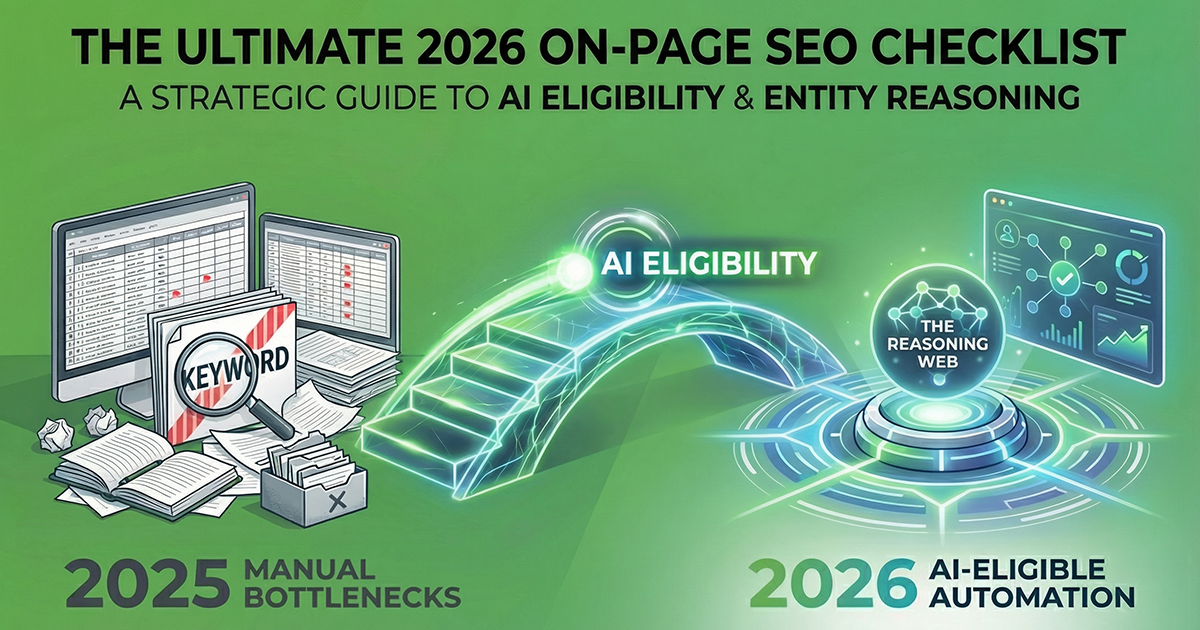
The Crisis of Manual Optimization: Why Your 2025 Strategy is Failing the Reasoning Web

Executing a high-performance 2026 on-page SEO strategy requires moving beyond familiar tactics and adopting a framework built for the reasoning web. Search is no longer built on a simple information web where pages connect through links and keywords alone. It now operates as a reasoning web where engines interpret meaning, relationships, and intent across connected concepts. By following this guide, you will learn how to transition from basic keyword optimization to a detailed entity-based strategy that secures your website’s place in AI-driven search results.
Search engines are increasingly answering questions instead of ranking pages. They synthesize information, evaluate consistency, and decide which sources are reliable enough to reference. Manual optimization practices, such as writing meta tags by hand or lightly adjusting keyword placement, still matter, but they now deliver limited returns on their own.
Stop fighting the old algorithm. If you want to skip the theory and get straight to the execution, download the No-Fluff 2026 On-Page SEO Checklist to audit your site for AI eligibility right now.
Access the Checklist Now!
Get the 2026 Execution Guide
The reasoning web changes how pages rank. This checklist provides you with the steps to secure AI citations and build human authority.
Generative AI and large language models have changed how content is processed. Systems like AI Overviews do not scan pages for phrases in isolation. They evaluate whether a page understands a topic at a conceptual level. Content that lacks structure, depth, or clear entity relationships struggles to be selected, even if it once ranked well. This shift introduces a new measurement standard.
The New Metric: Eligibility, Not Just Visibility
Traditional SEO focused on visibility, where rankings, impressions, and clicks were the main signals of success. In 2026, performance also depends on eligibility, as pages must qualify to be cited, summarized, and recommended by AI agents.
Performance is no longer just about appearing on page one. New indicators like citation frequency and AI Overview inclusion show whether your content is trusted as a primary source. This guide provides a framework to help you earn selection rather than just placement.
To achieve this, your website must be optimized for AI processing across three essential pillars:
- Technical Readiness: Ensuring your site is fast, accessible, and properly structured for machine ingestion.
- Conceptual Mapping: Developing a logical information flow that demonstrates a deep understanding of entities and their relationships.
- Human Trust: Providing original data and verified expertise that AI models cannot generate on their own.
The No-Fluff 2026 Execution Framework

To move from theory to results, we have organized the strategic requirements of the No-Fluff 2026 On-Page SEO Checklist into four practical phases. These stages help convert your pages from static text into high-authority nodes that search engines can easily reason with and recommend to users.
In this guide, you will learn how to:
- Establish Technical & Agentic Readiness by understanding Core Web Vitals, semantic document hierarchy, and crawl control for AI ingestion and accessibility.
- Build High-Trust Content using "Answer-First" snippets, unique information gain, and structured data chunking to secure AI Overview citations and satisfy E-E-A-T.
- Master Meta-Optimization & Intent by refining SERP appearance, mapping semantic triples for reasoning engines, and addressing the full conversational search loop.
- Scale Execution via Automation using quantitative benchmarks and rapid execution loops to resolve entity gaps and maintain contextual freshness.
Ready to turn this strategy into a step-by-step audit?
Don't get lost in the theory. Download the 2026 On-Page SEO Checklist Now. It includes specific benchmarks, recommended tools, and the exact workflow you need to bridge the gap between human value and machine reasoning.
Access Your No-Fluff 2026 On-Page SEO Checklist Now!
Get the 2026 Execution Guide
The reasoning web changes how pages rank. This checklist provides you with the steps to secure AI citations and build human authority.
Phase 1: Architectural Readiness & Machine Ingestion

This phase covers the structural and performance-based requirements that make a page readable for both AI agents and humans. In the Reasoning Web, technical health is no longer a "pass/fail" metric; it is a signal of reliability.
The scope of this phase includes a full audit of Core Web Vitals, specifically targeting LCP (Largest Contentful Paint), CLS (Cumulative Layout Shift), and INP (Interaction to Next Paint) to ensure the high responsiveness thresholds required for Agentic Readiness. It encompasses the establishment of a Semantic Structure that provides a clear logical hierarchy for machine mapping into knowledge graphs. This stage also incorporates URL Structure & Navigational Clarity, utilizing SEO-friendly slugs, entity placement, and Breadcrumbs to simplify the path for both users and crawlers. To safeguard data and ensure accessibility, the phase addresses Crawl Control. This involves managing specific agents via Robots.txt and llms.txt while maintaining WCAG Compliance. Finally, it includes the implementation of Structured Data Stacking to anchor your content’s entities to globally recognized IDs, making your authority undeniable.
Phase 2: Semantic Depth & The Information Gain Standard

Phase 2 shifts focus to the substance and presentation of your expertise. This stage is designed to satisfy the "Experience" requirement of E-E-A-T while establishing what search engines recognize as Information Gain & Unique Value. These are original insights that distinguish your pages from generic, AI-generated noise.
The scope of this phase includes the implementation of Answer-First Snippets to secure visibility in AI Overviews and an audit of Information Gain to identify unique data points, proprietary case studies, or custom visuals that provide value missing from competitor pages. It also encompasses Visual & Data Chunking, which involves organizing complex instructions into lists, utilizing next-gen image formats and lazy loading, and presenting comparative data in machine-readable table formats. To build authority, this phase incorporates E-E-A-T & Social Proof through author verification and primary data citations. Finally, it covers Internal Linking & Dynamic Engagement, building topical authority with entity-rich anchor text and intent-based recommendations to keep readers on the page.
Phase 3: Reasoning Alignment & Intent Mapping

This phase focuses on refining how your page is identified by AI reasoning engines and interpreted by human searchers in the SERP. It bridges the gap between machine-readable logic and human curiosity.
The scope of this stage includes SERP Appearance & CTR Optimization, which encompasses the use of entity-rich Title Tag hooks, benefit-driven Meta Descriptions, and Social Metadata to ensure clear representation when shared by agents. It also incorporates Semantic Triple Mapping, involving a Declarative Audit to ensure core facts use the active voice and Relationship Verification to confirm that primary entities are logically connected for AI knowledge graphs. Finally, the phase includes Contextual Fluency & Follow-up Intent, which covers the use of Predictive Intent to map secondary questions into the content and a Topic Exhaustion check to ensure the user journey is completed entirely on the page without missing logical steps.
Phase 4: Stop Manual Auditing - The Shift to Automated Execution

The final phase involves the transition from strategic mapping to a data-driven execution cycle. This stage recognizes that the complexity of the 2026 search environment requires automated benchmarking to maintain a competitive edge over manual auditing processes.
The scope of this phase includes Quantitative Performance Benchmarking, specifically targeting an Overall Content Score of 85+ to validate the alignment of technical and quality metrics. It also encompasses Entity Gap Resolution, utilizing automated analysis to identify and add suggested keywords that close knowledge gaps. Furthermore, this phase incorporates the deployment of a Quick Execution Loop, which facilitates live refinements within 48 hours of identifying search trend shifts to ensure content remains contextually fresh for both humans and AI agents
Strategic Execution Tip: You can manage these phases manually using our No-Fluff 2026 On-Page SEO Checklist, but for high-volume sites, manual tracking often leads to entity gaps that robots catch before you do.
Get the 2026 Execution Guide
The reasoning web changes how pages rank. This checklist provides you with the steps to secure AI citations and build human authority.
Stop Auditing, Start Automating
SinglePage SEO delivers the execution plan described in this guide in seconds. The complexity of the Reasoning Web means manual audits are now the bottleneck. While a checklist provides the map, automation provides the speed. The free content analysis tool generates an Overall Content Score, identifies suggested keywords, and produces a prioritized SEO Optimization Plan instantly.
PRO TIP:To win in 2026, write for people but organize your data for robots. When you help a human solve a problem and make it easy for a bot to see how you did it, your rankings will follow.
Stop Manual Auditing: Automate Your 2026 Strategy
Don't waste hours on manual spreadsheets. Use the SinglePage SEO Free Content Analysis Tool to calculate your webpage's health, resolve entity gaps, and get your 2026 Optimization Plan in one click.
Analyze Your Content Now